

or
We're not quite there yet
TL;DR: Riester 2.0’s fee cap has been lowered from 1.5% to 1%, and the incentives have been restructured. That narrows the gap with independent investing considerably: the optimized strategy (investing only up to the subsidized amount in Riester 2.0, the rest independently) now beats a pure ETF portfolio for everyone, and maxing out the plan only trails it without kids. But it only works if you stay in Germany, and the amounts involved are too small to fix anyone’s pension on their own.
This post is a follow-up on a previous post which looked at the new proposed "Riester 2.0", or Altersvorsorgedepot. Since then there have been some updates to the draft so I'm revisiting this topic with updated calculations.
You know how sometimes in blogs the writer tells you you should read another post before reading this one? And it's all a bit tiring? Not today! Here's the original post AND everything that's changed, all in one. Exciting, I know.
What was previously proposed, and what's changed?
The general idea
Savers will be able to open a designated trading account at one of several approved providers and deposit into that account as they want. Additionally, the state will add incentives on top of the deposited amounts, and it will grant savers certain tax benefits. The costs of this plan are regulated, but providers are allowed to ̶c̶h̶a̶r̶g̶e̶ ̶u̶p̶ ̶t̶o̶ ̶1̶̶̶.̶̶̶5̶̶̶%̶̶̶ ̶p̶e̶r̶ ̶y̶e̶a̶r̶ ̶i̶n̶ ̶f̶e̶e̶s̶.̶
This is probably the biggest change: the maximum allowed fee has been lowered to 1% instead of the previously proposed 1.5%. Doesn't sound like much? See the comparison table below - it makes quite a difference.
How much can you get?
Up to 1,200€/year, you'll get 30 Cents for every Euro. If you invest 1,200€, you get 360€ as a bonus (In 2029 this amount should increase to 35 Cents per Euro).
For the next 600€, from 1,201€ up to 1,800€, you get 20 cents per Euro, so that's another 120€.
In total, if you invest the maximum amount of 1,800€, you'll get a total of 480€ on top of that, making the grand total 2,280 Euro per year.
The specifics of the incentive mechanism also changed. While the total maximum incentivized amount remained unchanged (€1,800), the total cash incentive increased to €540. The tiers also changed, making it more attractive to lower earners, who presumably will invest less. Why? Because the weight shifted towards the 1st tier, which now gives you higher incentives than before, and the 2nd, lower tier, covers a bigger part of your deposits;
Old incentive mechanism:
Invested Amount
For every 1€ Invested, you get:
Maximum Incentive
1st Tier
Up to 1,200€
0.3€
360€
2nd Tier
1,201-1,800€
0.2€
120€
Maximum incentive
480€
New incentive mechanism:
For every 1€ Invested, you get:
Maximum Incentive
Up to 360€
0.5€
180€
361-1,800€
0.25€
540€
As you can clearly see above, there's a more aggressive incentive on the first 360€ you invest, and now the same lower 2nd-tier incentive is applied to a larger part of the total investment up to 1,800€ per year. In total, the maximum achievable amount increased from 480€ to 540€.
But wait, there's more: for every child of yours, who's eligible for child allowance (Kindergeld), you'll get an additional bonus of 300€/year.
The total incentive per child (Kinderzulage) stayed the same, but it's now dependent on your own investment: the state will match your investment, 1:1, up to 300€ per year, for every child that's assigned to your portfolio. Same as before, the child has to be eligible for Kindergeld.
Additional tax benefits
On top of the incentives, the total invested amounts (your own investments and the state incentives) will be considered as a deductible cost for tax purposes and can be used to reduce your overall tax burden.
If at this point it feels like it's a bit too good to be true, well - listen to your heart. Some hard truths are coming...
The Saving Phase
Let’s compare investors saving 1,000€/month over 30 years at a 7% return.
Some points worth mentioning:
- ̶I̶ ̶i̶n̶d̶e̶e̶d̶ ̶a̶s̶s̶u̶m̶e̶d̶ ̶t̶h̶a̶t̶ ̶f̶r̶o̶m̶ ̶2̶0̶2̶9̶,̶ ̶t̶h̶e̶ ̶b̶a̶s̶e̶ ̶i̶n̶c̶e̶n̶t̶i̶v̶e̶ ̶j̶u̶m̶p̶s̶ ̶f̶r̶o̶m̶ ̶3̶0̶c̶ ̶t̶o̶ ̶3̶5̶c̶ ̶p̶e̶r̶ ̶€̶1̶ ̶(̶bringing the first-tier maximum to €420 and the total to €540)̶.̶ This is no longer relevant.
- Child Cap: The €300/child bonus is a great "instant return," but the maximum duration for a child to receive child allowance is 24 years (might be less but I wanted to be optimistic in terms of benefits and incentives). In our 30-year example, I've assumed two kids are born in Year 1. You get the bonus for 24 years, then it vanishes.
- Effective Tax Shield: If you are a high earner (42% bracket), your tax deduction is worth ~€957. BUT: Since the €480 bonus you already received is deducted from that amount, you're left with an effective tax shield of €477. In the calculation below, this amount is reinvested back into the pot. The numbers changed a bit but the principle remained the same. It's now a potential tax shield of ~€983, from which we deduct the maximum amount of €540, and we're left with an overall similar €443 effective tax shield.
- Fees: as mentioned above, providers will be allowed to charge "up to" 1.5%. This is pretty much like telling a T-rex it can eat "up to" 10 sheep. I wouldn't expect it to spare any sheep out of kindness, so we have to assume a 1.5% annual fee. Under the final law, the 1% cap applies only to the standard depot. The Individual depot has no cost cap.
I've looked at a few different alternatives:
- DIY: You invest the entire 1,000€ into a low-cost ETF portfolio
- Max. Riester 2.0: you invest up to €6,840/year into the new Riester plan and the rest into a DIY ETF portfolio.
- Optimized: you deposit into the Riester 2.0 plan the maximum amount that is incentivized, to maximize benefits, and the rest goes into a low-cost ETF portfolio.
Here are the older calculations, based on the previous assumptions:
Let's see what you'd get in each scenario:
Total amount accumulated at the end of the 30-Year period:
Strategy
Total Value
vs. Pure ETF
100% DIY ETF (0.2% fee)
€1,133,000
Max. Riester 2.0 - No kids (1.5% fee)
€1,074,000
-€59,000
Max. Riester 2.0 - 2 Kids (1.5% fee)
€1,112,000
-€21,000
Optimized - Single, No kids
€1,174,000
+€41,000
Optimized - 2 Kids
€1,212,000
+€79,000
Optimized Strategy: Investing only up to the subsidized limit (~€1,800 + bonuses) in the Depot; the rest in a low-cost broker.
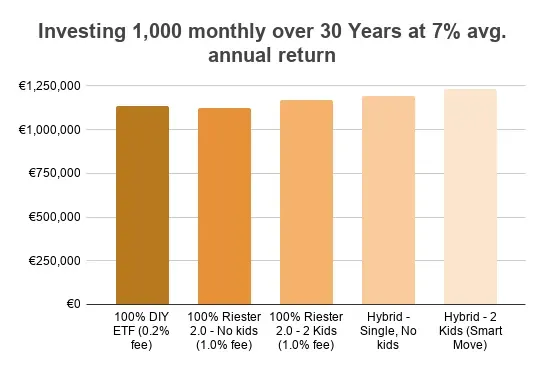
And, here are the updated ones:
Max. Riester 2.0 - No kids (1.0% fee)
€1,125,000
-€8,000
Max. Riester 2.0 - 2 Kids (1.0% fee)
€1,167,000
+€34,000
€1,190,000
+€57,000
€1,232,000
+€99,000
As you can see, the overall picture stayed pretty much the same, but the gap definitely closed. In fact, only one scenario (Max. Riester 2.0, no kids) still trails a DIY portfolio.
Here are the old results in a chart:
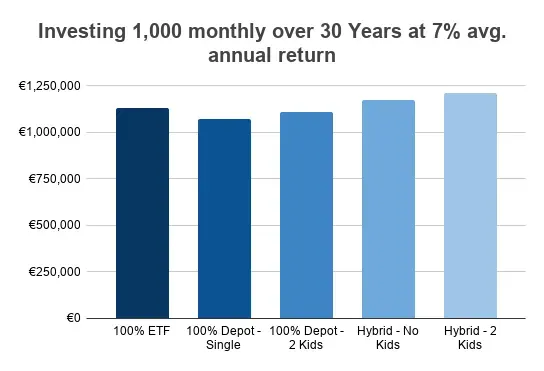
For a single with no kids, maxing out the Riester 2.0 plan means paying around €91,000 in fees, and ending up about €60,000 behind a simple ETF portfolio.
And here are the new ones:
The Real Tax Benefit (and why it’s a loan, not a gift)
Like every other private long-term saving product in Germany, one of its key selling points is tax savings in one way or another. Here as well, if you're earning well, you'll love the Sonderausgabenabzug (special expense deduction). This is how it works:
As already mentioned above, the real tax saving is not 983€, but rather 983-540=443. However, never forget: this is a tax-deferred product. You save taxes at 42% today, but you will pay your full personal income tax rate on every single Euro (principal + all gains) when you withdraw it. In a private ETF, you only pay 18.46% tax on the gains.
The Payout Phase: Freedom vs. "The Factor"
Accumulating the money is only half the battle. The real "hidden fee" appears when you try to spend it.
The DIY ETF Portfolio (The "3.5% Rule")
- Withdrawal: In my calculation, I assumed you can withdraw 3.5% of your total portfolio value in the first year and then adjust it for inflation. It's basically a more conservative version of the more well-known 4% rule. In our case, you withdraw €40,075 before tax.
- Taxation: You pay a flat 18.46% effective tax on profits only.
- Flexibility and full control: You own the shares. You decide. If you want to increase/decrease the withdrawals, permanently or just once, you can. If you pass away, your family inherits the full balance.
The Altersvorsorgedepot (The "Rentenfaktor" Trap)
- The Factor: Providers use a Rentenfaktor to calculate your monthly payout. Because they have to insure themselves against you living to 120, they often pay out the equivalent of only 2.5% to 3% (or lower), significantly lower than the DIY rate.
- Full Taxation: Your monthly allowance is taxed as full income. If you have a decent state pension, rental income or any other income source, your tax rate on these withdrawals will be much higher than 18.46%.
- The "Exit" Tax: While not all details have been finalized, looking at other similar incentives, it's reasonable to expect that if you move outside the EU (USA, UK, Switzerland), you'll be required to repay all bonuses and tax breaks in one lump sum.
Final Verdict
At 1% annual fees, the new Riester plan looks considerably better than the first draft. Compared with a simple, low-cost ETF portfolio:
- The optimized strategy works for everyone. With or without kids, investing only up to the incentivized amount and the rest in ETFs beats a pure ETF portfolio.
- Maxing out the plan still pays off with kids, but only just. Anything above the incentivized amount pays the full fee without earning any extra incentive.
- You need to stay in Germany. Plans change, life happens. Being heavily “fined” for moving away is not something anyone would choose to add to the mix.
And so we end up with a product that’s genuinely useful in the right circumstances, but still far from great.
What would have made it great? Lower fees, simple as that. In the last year of our example, the 1% fee on a maxed-out plan is around €5,700, still most of the €6,840 you deposit that year. All that for “managing” a simple ETF portfolio.
But to me, there's a bigger question: Is the proposed Riester 2.0 a real change in the German pension landscape? Unfortunately, my answer would be no. It's not.
The only case where it makes clear sense is in combination with a simple, independent investment into a low-cost ETF portfolio. But for anyone who's capable of doing that, this doesn't solve any real problem. It simply ties them down to an expensive product, which serves more as a "loyalty program" to Germany itself, than a real, tax-optimized, simplified long-term investing product.
And another thing: it's nice to compare scenarios and run calculations, but zoom out for a moment and consider the actual amounts: the fully incentivized amount is 1,800€ PER YEAR. With the added incentives, even with 3 kids, we're still in the 3,000 region. This is a very low amount. Alone, this amount will not solve anyone's pension problem.
A real change in the system, a true revolution, will only come when the default plan is built so that in most reasonable scenarios it can provide a good standard of living for a person who worked their entire life and contributed into the system. Riester 2.0 is very, very far away from that.